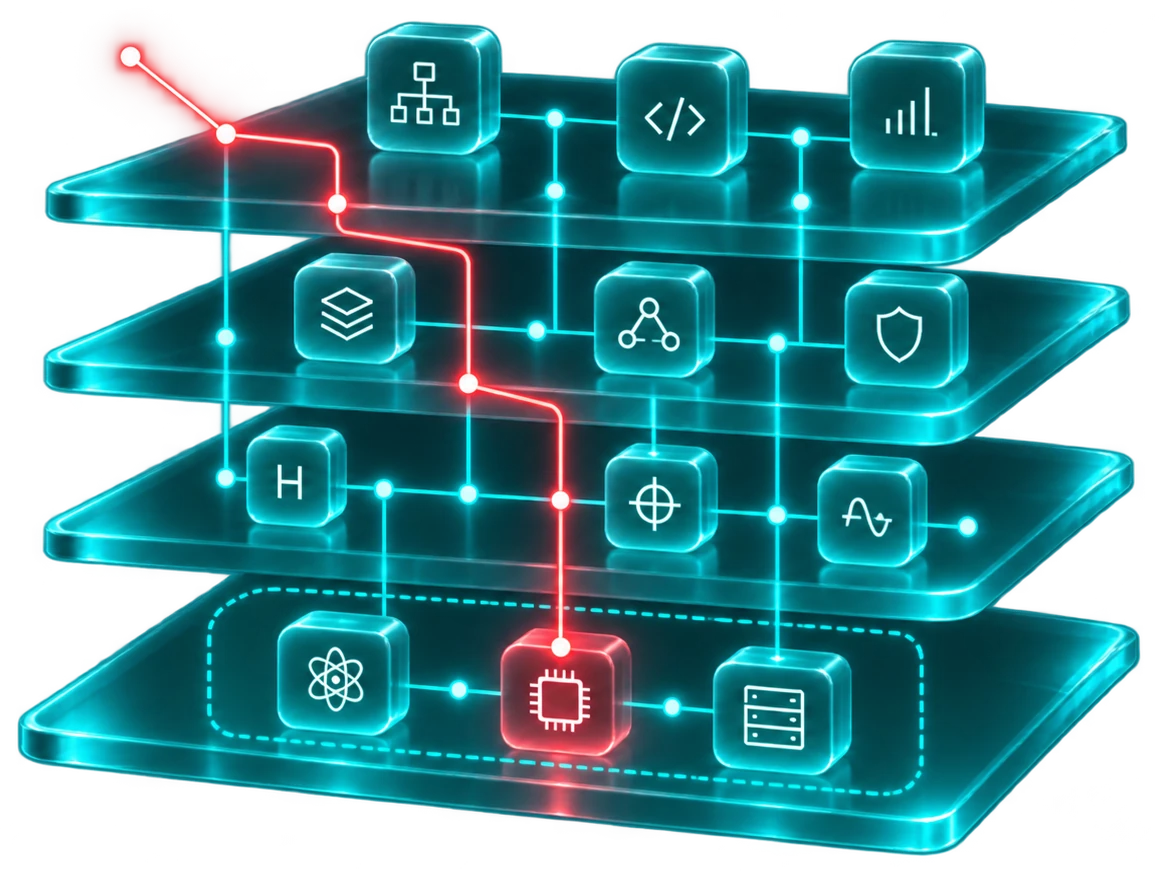

Quantum ML Security
Adversarial perturbations, poisoning, backend-dependent noise and deployment shift.
QUANTUM SOFTWARE SECURITY
QLYMPUS secures quantum and hybrid AI software through threat modeling, adversarial testing and measurable robustness validation.
THE SECURITY GAP
Quantum software is moving from isolated research code toward hybrid systems, cloud backends and operational workflows.
That changes the question from “does it work?” to “what happens when someone actively tries to make it fail?”
Adversarial perturbations, poisoning, backend-dependent noise and deployment shift.
Threat models for quantum-classical stacks, orchestration layers and software dependencies.
Repeatable experiments, measurable thresholds and evidence engineering teams can act on.
Mission-aware security where integrity, availability and controlled degradation matter.
QLYMPUS METHOD
Security engineering for quantum systems should be testable, reproducible and explainable.
DEFENCE & CRITICAL SYSTEMS
Defence use cases amplify the consequences of manipulated models, unreliable backends and unverified dependencies. We focus on attack paths that can influence decisions, availability and trust — not only benchmark accuracy.
RESEARCH-LED SECURITY
QLYMPUS translates research on attacks and robustness into practical security validation.
Adversarial attacks, stochastic device noise and backend-dependent deployment variability in QML.
View publicationKnown attack vectors across quantum computing and QML, with cybersecurity countermeasures and lifecycle implications.
View publicationOUR PRINCIPLE
Measure
what breaks.
Then harden the system and prove that the security margin improved.
MEET US AT Q-DEF 2026
QLYMPUS will exhibit at Q-DEF — Quantum for Defence in Luxembourg. Visit us to discuss adversarial QML, quantum software attack surfaces and security validation for emerging defence use cases.
 (opens the Q-DEF conference website in a new tab)
START WITH THE THREAT MODEL
Tell us what you are building. We start with the assets, assumptions and attack paths that matter most — and turn them into a testable security scope.